You Won’t Believe These Jaipur Views – My Jaw-Dropped Moments
Jaipur, the Pink City, isn’t just about palaces and bazaars—its real magic lies in the way the light hits the hills at sunset or how the city spreads out beneath you like a living tapestry. I went searching for the best viewpoints, and what I found blew my expectations away. From hidden rooftop cafes to quiet hilltop forts, each spot offered a unique perspective—not just of the city, but of Rajasthan’s soul. These elevated moments didn’t just give me postcard-worthy photos; they offered stillness, clarity, and a deeper connection to a place where history, color, and landscape converge in breathtaking harmony.
The Allure of Jaipur’s Skyline
Jaipur’s skyline is more than a collection of rooftops and spires—it is a symphony of design, color, and topography that reveals its full beauty only when seen from above. Built in the 18th century by Maharaja Sawai Jai Singh II, the city was planned with geometric precision, its grid-like structure reflecting both astronomical insight and aesthetic intention. When viewed from elevation, the pink-hued buildings—painted in compliance with a 19th-century decree to welcome a royal guest—blend seamlessly into a warm, rosy landscape that glows at dawn and dusk. This visual harmony is no accident; it is the result of deliberate urban planning, where every street, market, and temple contributes to a larger architectural vision.
What makes Jaipur’s elevated views so powerful is not just their aesthetic appeal, but the emotional resonance they evoke. From above, the city transforms from a bustling urban center into a living map of culture and continuity. The Aravalli Hills, among the oldest mountain ranges in the world, cradle the city and provide natural vantage points that have been used for centuries—not only for defense but for contemplation. These hills offer a sense of timelessness, grounding the viewer in a landscape that has witnessed empires rise and fall. Standing atop one of these perches, you’re not just observing Jaipur—you’re becoming part of its story.
Viewpoints in Jaipur serve a purpose beyond tourism. They offer a pause in the rhythm of travel, a chance to absorb the scale and spirit of a destination that can otherwise feel overwhelming in its richness. While many visitors focus on checking off landmarks, those who seek height often find meaning. Whether it’s the quiet moment watching the sun dip behind distant fort walls or the sudden awareness of how life unfolds in the streets below, these perspectives deepen the journey. In a world where travel is often rushed, Jaipur’s high places invite stillness, reflection, and a renewed sense of wonder.
Nahargarh Fort: Where the City Unfolds at Dusk
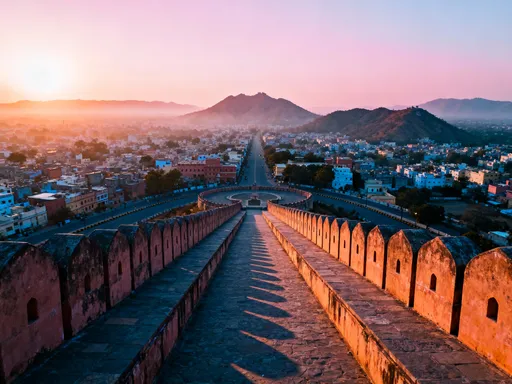
Perched on the edge of the Aravalli Hills, Nahargarh Fort offers one of the most expansive and emotionally stirring views in all of Rajasthan. As the sun begins its descent, the sky melts into shades of amber, rose, and lavender, casting a golden glow across the city below. From the fort’s broad ramparts, Jaipur stretches out like a hand-drawn map—pink rooftops, winding lanes, and the geometric layout of the old city visible in crisp detail. To the north, the silhouette of Jaigarh Fort rises on the horizon, while to the east, the Amber Fort glimmers in the fading light. This is not just a view; it is a living panorama that shifts with the hour and the season.
Originally built in 1734 as a retreat for the royal family and later expanded as a defensive structure, Nahargarh’s location was chosen for its strategic advantage—commanding views of approaching armies. Today, that same vantage point draws travelers seeking beauty rather than battle. The fort is easily accessible by car or taxi from the city center, with a well-paved road winding through the hills. While there is a small entry fee for both domestic and international visitors, the experience is well worth the cost. The fort remains open until late evening, making it one of the best places in Jaipur to witness sunset in comfort and safety.
As daylight fades, the atmosphere at Nahargarh becomes almost festive. Locals arrive with families, couples find quiet corners to sit, and photographers line up along the stone parapets. The air cools quickly at this elevation, carrying the scent of wild herbs and dry earth. Street vendors sell chai and snacks near the entrance, adding to the sense of warmth and community. One of the lesser-known highlights is the Jaivana Cannon, once one of the largest wheeled cannons in the world, which sits within the fort complex and offers a tangible link to Jaipur’s martial past. The blend of Rajput and Mughal architecture—seen in the curved domes, arched colonnades, and intricate stonework—adds to the site’s visual richness.
For those seeking a deeper experience, a short walk beyond the main fort leads to quieter spots with unobstructed views. Here, the city lights begin to twinkle like scattered stars, and the sounds of traffic fade into the background. It is in these moments—when the world seems to slow—that the true magic of Nahargarh reveals itself. This is not just a place to take photos; it is a place to feel the pulse of Jaipur from a distance, to witness its beauty with both awe and gratitude.
Amber Fort’s High Terraces: Power and Perspective
While Amber Fort is renowned for its grand courtyards, mirrored halls, and elephant statues, some of its most powerful experiences come not from within, but from above. The fort’s elevated terraces—particularly those overlooking the Sheesh Mahal and Sukh Niwas—offer commanding views of the surrounding valley, Maota Lake, and the distant Jaipur skyline. These vantage points were not accidental; they were designed by Rajput architects to serve both aesthetic and strategic purposes. From here, the royal family could monitor movement on the roads below, receive early warnings of approaching forces, and enjoy private moments of reflection above the bustle of court life.
The Sheesh Mahal, or Mirror Palace, is famous for its intricate glasswork, but few visitors realize that climbing the adjacent stairways leads to quiet overlooks with panoramic sightlines. Standing at this height, one gains a new appreciation for the fort’s scale and placement. Built into the hillside using pale yellow sandstone and marble, Amber Fort was engineered to blend with the natural terrain while remaining impregnable. From the terraces, you can trace the fort’s layered defenses—the series of gates, ramparts, and concealed passages that once protected the kingdom. The view of Maota Lake, which serves as the fort’s primary water source, is especially serene in the early morning, when mist hovers above the water and birds glide silently across the surface.
Sukh Niwas, known as the “Hall of Pleasure,” opens onto a terrace shaded by trees and cooled by a natural breeze. This was a favorite retreat for royalty during the scorching summer months. Today, it remains one of the most comfortable spots to pause and absorb the landscape. The contrast between the fort’s cool interiors and the sunlit valley below is striking. Visitors are advised to arrive early in the day—ideally between 8:00 and 10:00 AM—to avoid both the midday heat and the largest crowds. Late afternoon also offers beautiful lighting, though the site begins to close by 5:30 PM.
For families and older travelers, reaching these upper levels requires moderate walking and some climbing, but the effort is rewarded with solitude and sweeping vistas. Unlike the crowded courtyards below, these high terraces often remain quiet, allowing for personal moments of connection with the past. The sense of history is palpable—not as a distant concept, but as a living presence in the stones, the wind, and the view. Amber Fort’s elevated spaces remind us that true power was never just about strength, but about perspective.
Jal Mahal’s Waterside Vista – Beauty with Limits
No image is more iconic to Jaipur than Jal Mahal, the Water Palace, floating serenely in the middle of Man Sagar Lake. Its five-story structure, with only the top floor visible above water, creates a dreamlike silhouette against the sky. While many travelers hope to visit the palace up close, access remains restricted—visitors are not allowed to enter or approach by boat, a measure taken to preserve the fragile ecosystem of the lake and the building itself. However, this limitation does not diminish the experience; instead, it transforms the viewing into an act of appreciation from a distance.
The best vantage points for Jal Mahal are along the Gangaur Ghat road or from the nearby embankment known as Jal Mahal Viewpoint. These locations offer unobstructed sightlines and are easily accessible by car or auto-rickshaw. Early morning is ideal, when the lake is still and the rising sun casts a soft glow on the palace’s pink façade. At this hour, the area is often quiet, with only a few photographers and local walkers enjoying the calm. The reflection of the palace in the water—when undisturbed by ripples—creates a perfect mirror image that feels almost surreal.
In the evening, the experience shifts. As dusk settles, the palace is softly illuminated with warm yellow lights, making it glow like a lantern on the water. This is a popular time for families and couples to gather along the roadside, sipping tea from nearby stalls and taking photographs. While the surrounding area lacks extensive seating or facilities, the simplicity of the moment—the stillness of the lake, the quiet chatter of onlookers, the distant hum of the city—adds to its charm. Birdwatchers may also spot migratory species, including kingfishers and egrets, that inhabit the lake’s reed beds.
Though you cannot step inside Jal Mahal, its visual impact remains profound. It serves as a reminder that not every meaningful travel experience requires access or interaction. Sometimes, beauty is most powerful when it remains just out of reach—inviting contemplation rather than consumption. The palace, suspended between water and sky, becomes a symbol of tranquility in a fast-moving world, a quiet invitation to pause and simply look.
Panna Meena Ka Kund: A Stepwell with a View
Hidden in the shadow of Amber Fort, Panna Meena Ka Kund is a masterpiece of both engineering and artistry. This 16th-century stepwell, built in the traditional Rajput style, was originally designed to provide water and serve as a gathering place. But today, it is equally cherished for its architectural symmetry and the elevated perspectives it offers. The stepwell’s design—featuring perfectly aligned, crisscrossing staircases that form a giant geometric pattern—creates a natural amphitheater that draws the eye upward. As you climb the steps, the view expands: first revealing the surrounding greenery, then the fort walls, and finally, the distant hills.
Unlike many tourist-heavy sites, Panna Meena Ka Kund remains relatively peaceful, especially in the early morning hours. This makes it an ideal spot for quiet reflection or a gentle start to the day. The stone steps, carved from local sandstone, are cool underfoot and shaded by overhanging trees, providing relief from Jaipur’s intense sun. The symmetry of the structure is not just visually pleasing—it is meditative, encouraging a slower, more mindful way of moving through space. Families often visit with children, who enjoy the sense of exploration, while photographers capture the interplay of light and shadow as the sun rises.
The stepwell’s location, just a short walk from Amber Fort, makes it an easy addition to any itinerary. Yet, many visitors overlook it in favor of more famous landmarks. Those who take the time to explore it discover a place that feels both ancient and intimate. The sound of footsteps echoing against the stone walls, the rustle of leaves in the breeze, and the occasional call of a peacock from the nearby forest create a sensory experience that is rare in busier parts of the city. From the top of the steps, you gain a quiet vantage point over the entrance road to Amber Fort, watching elephants, tourists, and guides move in a steady rhythm below.
Panna Meena Ka Kund is a reminder that beauty often lies in overlooked places. It does not demand attention with grandeur or spectacle, but earns it through balance, harmony, and stillness. For travelers seeking depth over dazzle, this stepwell offers a moment of grounding—a chance to connect with history, nature, and oneself in a single, silent ascent.
Hidden Rooftop Experiences in the Old City
While forts and stepwells offer dramatic views, some of Jaipur’s most authentic elevated experiences come from the rooftops of the old city. Tucked within the bustling lanes of Johari Bazaar, Chand Pol, and Tripolia, a number of traditional havelis and guesthouses have opened their terraces to visitors, offering intimate vantage points over the city’s vibrant life. These rooftop spaces—often adorned with colorful cushions, brass lanterns, and potted plants—provide a front-row seat to Jaipur’s daily rhythm: rickshaws weaving through narrow streets, vendors calling out their wares, and the distant chime of temple bells.
One of the most rewarding experiences is sipping masala chai on a quiet rooftop at sunset, watching the pink buildings deepen in hue as the light changes. Unlike commercial restaurants with panoramic glass walls, these smaller, family-run spaces emphasize hospitality and authenticity. Many offer traditional Rajasthani snacks—like pyaaz kachori or ghewar—served on brass platters, enhancing the sensory richness of the moment. The atmosphere is relaxed, with no pressure to order multiple dishes or leave quickly. Instead, guests are often welcomed like family, invited to linger and enjoy the view.
For safety and comfort, it is recommended to visit verified establishments that maintain clean, secure terraces with proper railings and lighting. Some guesthouses, such as those in the Chand Pol area, offer rooftop seating exclusively to their guests, while others partner with local tour operators to host small cultural evenings with folk music or storytelling. These experiences are not widely advertised, preserving their charm and preventing overcrowding. Travelers who seek them out are often rewarded with personal interactions, local insights, and views that cannot be captured from a tour bus.
These urban viewpoints remind us that elevation is not only about geography, but about perspective. From a rooftop in the old city, you see not just buildings and streets, but the pulse of everyday life—the laughter of children, the call to prayer, the rhythm of commerce and community. It is a view that connects you to the present, even as you stand above it. In a city known for its monuments, these quiet rooftops offer something just as valuable: a sense of belonging.
Why Viewpoints Define Your Travel Memory
When we return from a journey, what stays with us is rarely the checklist of places visited. Instead, it is the moments of stillness—the sudden silence atop a fort, the golden light over a lake, the feeling of being small beneath a vast sky. In Jaipur, these elevated experiences become emotional anchors, shaping how we remember the city and ourselves within it. A viewpoint is more than a photo opportunity; it is a pause in time, a chance to absorb, reflect, and feel. It is where the mind quiets and the heart opens.
There is a psychological truth in this: physical height often brings emotional clarity. When we rise above the ground, we gain not just a broader view, but a broader mindset. The worries that felt urgent on the street below seem smaller from above. The noise fades. The perspective shifts. In that space, realizations emerge—not through effort, but through presence. For many travelers, especially women balancing family, work, and personal dreams, these moments are rare and precious. They offer a chance to breathe, to remember who you are beyond roles and routines.
In Jaipur, these high places do more than showcase scenery—they invite introspection. Whether standing on a centuries-old rampart or sipping tea on a quiet rooftop, you are given the gift of distance. And from that distance, you see not only the city, but your own life with fresh eyes. These viewpoints become memory markers, not because they are grand, but because they are felt. They linger in the mind long after the souvenirs are put away, becoming part of your inner landscape.
Conclusion: Rise Above the Ordinary
Jaipur’s true magic is not only in its palaces, markets, or festivals, but in the way it lifts you—literally and emotionally. From the golden silence of Nahargarh at dusk to the quiet symmetry of Panna Meena Ka Kund, from the regal heights of Amber Fort to the intimate rooftops of the old city, each viewpoint offers more than a scene. It offers a shift—a moment of elevation that changes how you see and feel. These experiences remind us that travel is not just about moving from place to place, but about gaining new perspectives.
In a world that often feels rushed and surface-level, Jaipur invites you to rise above. To seek not just the famous, but the meaningful. To find stillness amid beauty, and clarity amid color. For the 30- to 55-year-old woman balancing life’s many demands, these moments are not indulgences—they are necessities. They restore energy, spark inspiration, and reconnect you to a sense of wonder that never ages.
So as you plan your journey, look beyond the guidebook. Seek the high places. Climb the steps, find the quiet terrace, wait for the light. Let Jaipur show you not just its skyline, but its soul. And when you return home, you’ll carry more than memories—you’ll carry a new way of seeing, one that stays with you long after the trip ends.