You Won’t Believe These Secret Spots in Saint Petersburg
Imagine standing where the city unfolds like a painted canvas—golden domes glowing at sunrise, canals shimmering under soft twilight, and views so breathtaking they stop you mid-step. I stumbled upon Saint Petersburg’s most unseen vantage points while wandering off the tourist trails. These aren’t just pretty postcard angles—they’re real moments of awe, known mostly to locals. If you're craving authentic beauty and soul-stirring perspectives, this is your invitation to see the city like never before. Beyond the Hermitage and Palace Square lies a quieter, more intimate Saint Petersburg—one revealed only to those willing to look up, step aside, and explore with curiosity and care.
The Magic of Seeing Saint Petersburg from Above
Saint Petersburg is a city designed to be admired from above. From elevated vantage points, its grand urban plan reveals itself—a harmonious blend of Baroque symmetry, Neoclassical precision, and waterways that weave through the districts like silver threads. When you rise above street level, the city transforms. Cobblestone lanes become intricate patterns, rooftops unfold in a mosaic of green, gray, and gold, and the Neva River stretches like a liquid highway, reflecting the sky and skyline in perfect balance. This shift in perspective does more than offer a scenic reward; it creates a moment of clarity, a pause in which the soul can absorb the city’s rhythm and history.
The emotional impact of viewing Saint Petersburg from height cannot be overstated. It’s not merely about seeing more—it’s about seeing differently. At ground level, the scale of the city can feel overwhelming, even chaotic. But from above, the chaos resolves into order. You begin to understand how architects like Rastrelli and Rossi shaped a capital meant to rival Venice and Paris. The city’s layout, conceived by Peter the Great and refined over centuries, becomes legible. You see how major avenues radiate from central points, how bridges align with ceremonial routes, and how the placement of spires and domes guides the eye across the horizon.
Light plays a crucial role in these elevated experiences. During the White Nights of summer, when the sun barely sets, the city glows in a perpetual golden haze. From a rooftop or tower, the skyline appears bathed in soft amber, with silhouettes stretching long across the water. In winter, the low-angled sun casts dramatic shadows, turning snow-dusted rooftops into a monochrome etching. Even on overcast days, the interplay of cloud and architecture creates mood and mystery. The best moments often come at dawn or dusk, when the city transitions between light and dark, and the first or last rays catch the gilded spires just right.
Weather, too, shapes the experience. A light mist rolling in from the Gulf of Finland can soften the skyline, turning distant domes into ghostly outlines. Rain brings out the deep colors of painted facades, while frost coats iron railings and cupolas in delicate lace. Each condition offers a new version of the city, a different story told through light and shadow. For the mindful traveler, these fleeting moments are not distractions—they are the essence of Saint Petersburg’s charm.
Rooftop Secrets: A Hidden World Beyond the Crowds
While most visitors follow the well-trodden paths through Nevsky Prospekt and the Winter Palace, a growing number of travelers are discovering a quieter, more personal side of Saint Petersburg—its rooftops. Tucked within historic buildings, some of these elevated spaces are accessible to the public, offering panoramic views without the queues or noise of major attractions. These are not commercial observation decks but intimate terraces, often managed by cultural centers, boutique hotels, or former merchant houses restored with care.
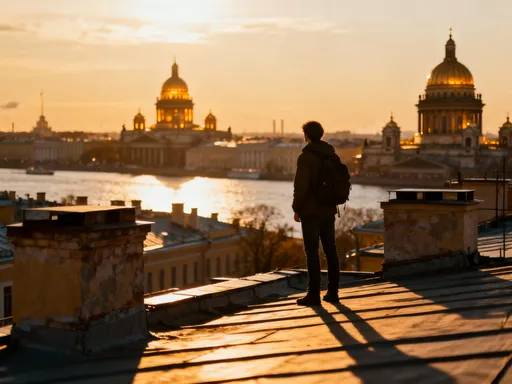
One such hidden gem is a 19th-century merchant residence near the Fontanka River, where a discreet staircase leads to a rooftop terrace open to visitors during cultural events and summer evenings. From this vantage, the city spreads in every direction—the golden spire of the Admiralty piercing the skyline to the west, the onion domes of the Church of the Savior on Spilled Blood glowing in the distance, and the Neva River winding through bridges and embankments. On clear days, you can see as far as the Peter and Paul Fortress, its needle-like spire standing sentinel over the city’s birthplace.
What makes these rooftop experiences so special is their sense of intimacy. Unlike crowded tourist spots, these spaces often feel private, even when shared with a few others. The air is still, the sounds of the city muted. You might hear only the distant chime of church bells or the soft rustle of flags in the wind. There’s time to breathe, to take in the view slowly, to notice how the light shifts across the water or how shadows move across a dome. It’s a meditative experience, one that allows for genuine connection with the city’s atmosphere.
Some of these rooftops also host small cultural programs—poetry readings, jazz nights, or art installations—adding another layer to the visit. These events are often announced through local cultural networks or museum websites, making them accessible to informed travelers. The key is to plan ahead and check for openings, as access is sometimes limited to certain days or seasons. But for those who make the effort, the reward is a rare and authentic encounter with Saint Petersburg—one that feels earned, not handed out.
Church Towers and Golden Domes with a View
For centuries, the tallest structures in Saint Petersburg were its churches. Their bell towers and cupolas were not only spiritual symbols but also functional vantage points, offering guardians and priests a view over the city. Today, many of these sacred spaces welcome visitors to climb their heights, combining spiritual heritage with breathtaking panoramas. Among the most renowned is St. Isaac’s Cathedral, where a narrow spiral staircase leads to a colonnaded gallery just beneath the gilded dome.
Climbing St. Isaac’s is an experience in itself. The ascent involves 262 steps, winding through dimly lit passages with occasional windows offering partial views. As you rise, the city gradually comes into focus—first the surrounding rooftops, then the river, and finally, from the top, a sweeping 360-degree vista. On a clear day, you can see across the entire historical center, from the Smolny Cathedral to the Spit of Vasilievsky Island. The golden dome of the cathedral itself reflects the sun like a mirror, casting light onto the streets below. It’s a powerful reminder of how architecture can shape both skyline and spirit.
Another unforgettable climb awaits at the Church of the Savior on Spilled Blood. While the church is famous for its colorful, mosaic-covered exterior, few realize that guided tours occasionally include access to upper levels with framed views of Nevsky Prospekt and the Griboyedov Canal. These are not public observation decks, but special access points arranged through the church’s visitor program. The experience is more intimate than at St. Isaac’s, with smaller groups and a focus on historical context. As you look out over the canal, you might see swans gliding past pastel-colored buildings, their reflections rippling in the water—a scene that feels timeless.
The emotional resonance of viewing the city from a church tower is unique. It’s not just about the height or the view; it’s about the sense of elevation in a deeper sense. Standing in a space once reserved for prayer and contemplation, you feel a quiet reverence. The city below seems both grand and fragile, a human creation shaped by vision and labor. The sound of bells, when they ring, adds to the atmosphere, their deep tones vibrating through the stone and air. For many visitors, this blend of beauty, history, and stillness is the most memorable part of their journey.
Bridges That Become Observation Decks at Night
Saint Petersburg is a city of bridges—over 300 span its rivers and canals, but none are more dramatic than the drawbridges that open each night during the navigation season. From late April to early November, these engineering marvels lift their spans to allow ships to pass, transforming the waterfront into a nightly spectacle. For travelers seeking a unique vantage point, the bridges themselves become temporary observation decks, offering front-row seats to one of the city’s most iconic rituals.
The Palace Bridge, connecting Palace Square to Vasilievsky Island, is perhaps the most famous. As midnight approaches, traffic clears, barriers go up, and pedestrians gather along the railings. The atmosphere is hushed, expectant. Then, with a deep mechanical hum, the central sections begin to rise, tilting skyward like the wings of a great iron bird. The lights of the city reflect in the dark water, doubling the spires and domes in shimmering symmetry. When fully open, the bridge forms a perfect X against the night sky, a silhouette of industrial grace.
Other bridges offer equally stunning views. The Trinity Bridge, with its elegant arches and ornate lampposts, opens with a slower, more deliberate motion, its central span lifting vertically. From the embankment near the cruiser Aurora, you can watch as the blue lights along the bridge’s frame illuminate the water, creating a dreamlike effect. The Liteyny Bridge and Volodarsky Bridge further downstream also draw crowds, each with its own rhythm and character.
What makes these moments so powerful is their blend of engineering and poetry. The sound of steel groaning, the slow ascent of metal, the reflection of palaces in still water—it’s a sensory experience that lingers. For families and couples, it’s a shared moment of wonder. For solo travelers, it’s a chance to pause and absorb the city’s nocturnal beauty. Photographers line the banks, adjusting tripods and settings to capture the perfect shot. But even without a camera, the memory of the bridge opening—the city breathing, stretching, revealing its inner mechanics—is unforgettable.
Quiet Corners Along the Canals: Peaceful Vistas Away from the Crowd
While the Neva River commands attention, Saint Petersburg’s smaller canals offer some of the most serene and picturesque views. These waterways, modeled after Venice’s, wind through residential neighborhoods, lined with pastel-colored buildings, arched bridges, and leafy embankments. They are less crowded than the main thoroughfares, making them ideal for quiet reflection and unhurried sightseeing.
One of the most enchanting stretches is along the Griboyedov Canal, particularly between Kazan Cathedral and the Church of the Savior on Spilled Blood. Here, swans glide through the greenish water, their movements creating gentle ripples that distort the reflections of Baroque facades. The embankments are paved with granite, dotted with benches and ornate lampposts. From certain angles, the view is perfectly framed—a golden dome centered between two 18th-century buildings, or a bridge arch enclosing a slice of sky and river.
Morning is the best time to visit. The light is soft, the air crisp, and the streets nearly empty. Bakers are just opening their shops, and the scent of fresh bread drifts from nearby courtyards. As the sun rises, it catches the gilded cupolas, setting them ablaze in gold. By late afternoon, the light shifts, casting long shadows and warming the stone facades. Evening brings a different mood—lamps flicker on, and the water turns dark, mirroring the city’s lights like a second sky.
Another hidden gem is the Kryukov Canal, south of the Field of Mars. Less frequented by tourists, it offers a glimpse into daily life in Saint Petersburg. You might see locals walking dogs, artists sketching by the water, or couples sharing quiet moments on benches. The buildings here are slightly more weathered, their colors faded, but this adds to the charm. It’s a place where history feels lived-in, not staged. For travelers seeking authenticity, these canal walks provide a deeper connection to the city’s soul.
Museums with a View: Culture Meets Panorama
In Saint Petersburg, culture and scenery often go hand in hand. Some of the city’s most important museums offer not only world-class collections but also exceptional views from their upper floors and café terraces. These spaces invite visitors to pause, reflect, and let the beauty inside mirror the beauty outside.
The Russian Museum, housed in the grand Mikhailovsky Palace, is one such place. While most guests focus on the art—icons, portraits, and avant-garde masterpieces—few realize that the upper-floor galleries overlook the Summer Garden and the Neva River. Large windows frame the landscape like living paintings. In spring, the garden bursts with color; in winter, it becomes a monochrome expanse of snow and iron railings. The contrast between the vibrant interiors and the serene exteriors creates a balanced experience—one of intellectual engagement and visual calm.
Another standout is the Erarta Museum of Contemporary Art, located on Vasilievsky Island. As the largest private museum of modern Russian art, it draws visitors with its bold exhibitions. But its true hidden treasure is the rooftop café, open during warmer months. From here, you can see across the Neva to the historic center, with the spire of the Admiralty and the domes of St. Isaac’s in clear view. The contrast between the cutting-edge art inside and the classical skyline outside is striking, yet harmonious. It’s a reminder that Saint Petersburg is both rooted in tradition and open to innovation.
Even smaller institutions, like the Anna Akhmatova Museum at Fountain House, offer quiet moments with a view. Set on the Fontanka River, the museum’s windows look out over shaded embankments and weeping willows. Sitting in the café with a cup of tea, you can imagine the poet writing by this same light, inspired by the river’s quiet flow. These spaces do more than display art—they create atmosphere, inviting contemplation and connection.
Planning Your View-Hunting Journey: Practical Tips for Travelers
Seeking out Saint Petersburg’s best views requires more than a map—it demands timing, preparation, and respect for the city’s rhythms. The first rule is to prioritize light. The golden hour—shortly after sunrise and before sunset—transforms the city, bathing its facades in warm, flattering light. The blue hour, just after sunset, offers cooler tones and dramatic silhouettes, ideal for photography. During the White Nights, when twilight lasts for hours, the city glows in a surreal, dreamlike haze, perfect for evening strolls and bridge openings.
Comfortable footwear is essential. Many of the best vantage points require climbing stairs—narrow, winding ones in churches, or steep paths along embankments. Supportive shoes with good grip will make the journey safer and more enjoyable. A light jacket is also advisable, especially on rooftops and bridges, where the wind can be strong even in summer.
For photography, a tripod is useful for low-light shots, especially during bridge openings. A wide-angle lens captures sweeping panoramas, while a zoom lens helps isolate distant domes and spires. But don’t let equipment distract from the experience. Sometimes, the most powerful moments are best remembered with the eyes, not the camera.
Access to certain viewpoints may require advance planning. Some rooftops and church towers have limited hours or require tickets purchased in person. Checking official museum and cultural center websites before your visit can save time and disappointment. Guided tours, especially those focused on architecture or photography, often include access to restricted areas and provide valuable context.
Finally, remember to travel with mindfulness. Saint Petersburg is a city of beauty and history, but it is also a living place. Respect quiet zones, avoid trespassing on private property, and be considerate of residents. The best travelers are not just observers but stewards—those who leave no trace and take only memories.
View-seeking in Saint Petersburg is more than a checklist of sights. It is a way of engaging with the city—slowly, thoughtfully, with wonder. Each vantage point offers not just a scene, but a story. Whether from a church tower, a quiet canal bench, or a midnight bridge, these moments accumulate into a deeper understanding of what makes this city so extraordinary. So look up, step off the main path, and let Saint Petersburg reveal itself—one breathtaking view at a time.